
As Saida Mirziyoyeva courted investors in Washington, a political prisoner’s brother travelled hundreds of kilometres for a hearing he was not allowed to attend.
Par Peter Leonard
Paru dans « A Central Asia Substack »

Saida Mirziyoyeva in Washington, Dauletmurat Tazhimuratov in Navoi. Uzbekistan as it is presented abroad and as it is experienced at home.
This week, two Uzbeks set out on two long but very different journeys.
One was Saida Mirziyoyeva, the ambitious and powerful daughter of the president. Her trip to the United States was an attempt at selling Uzbekistan as a modern country, open for business.
The other was Renat Tazhimuratov, the brother of a political prisoner. He travelled nearly 900 kilometres overnight to attend his brother’s latest court hearing, which was announced at last minute, only to be refused entry and left waiting outside.
The journeys tell of two versions of the same country: one polished and outward-facing; the other defined by opacity and arbitrary obstruction.
The hard sell
Mirziyoyeva’s tour of the United States began at Mar-a-Lago, the spiritual home of President Donald Trump’s universe. If she was expecting face time with Trump, her hopes were dashed as the president was otherwise engaged.
Her arrival in Florida came one day after Trump demanded that Iran “open the fuckin’ strait [of Hormuz], you crazy bastards,” and on the eve of his vow to obliterate Iran’s entire civilisation in the event of non-compliance. Mirziyoyeva’s father, Shavkat, will get to meet him, however, later this year at the next Board of Peace gathering in Miami.
In a photograph she later posted, Mirziyoyeva stands in a sand-coloured tailored suit, her jacket draped over her shoulders rather than worn, in some garishly gilded wing of the Mar-a-Lago estate alongside Sergio Gor, Trump’s Tashkent-born Central Asia point man. Also in the frame are one of President Trump’s daughters, Tiffany Trump, in a short dress with a cinched waist, something more suited to an evening reception than any formal engagement, and her husband, Michael Boulos.
The image set the tone for what followed: a sequence of engagements that moved uneasily between diplomacy, business outreach, and self-aggrandising glamour puffery.
The Washington leg of Mirziyoyeva’s expedition moved her through a sequence of meetings with a parade of oleaginously complaisant American bureaucrats and businessmen. Mirziyoyeva was accompanied at all times by her right-hand man, Komil Allamjonov, who was inexplicably sporting a black left eye.

Saida Mirziyoyeva, second from right, meeting with U.S. Secretary of State Marco Rubio, second from left. Mirziyoyeva’s right-hand man, Komil Allamjonov, can be seen at the furthest left in this image.
One event saw the formal launch of the U.S.-Uzbekistan Business and Investment Council, where Mirziyoyeva addressed the attendees in English. She was speaking “on behalf of the president of Uzbekistan,” Mirziyoyeva informed her listeners, dragging out the last syllable of her country’s name in a nasal, mid-Atlantic drone.
Other highlights included talks with senior officials and financiers on expanding trade, attracting investment, and underwriting risk. The program also brought Mirziyoyeva into contact with Secretary of State Marco Rubio and the leadership of the U.S. International Development Finance Corporation, where discussions centred on mobilising American capital in the direction of Uzbekistan. The Americans are especially eager to get their hands on whatever critical minerals the Uzbeks have to offer.
Separate talks with U.S. Trade Representative Jamieson Greer turned to regulatory alignment and Uzbekistan’s long-running bid to join the World Trade Organisation, the future of which has been placed under unprecedented strain by the Trump administration’s erratic and disruptive weaponisation of tariffs.
On the fourth day of her stay, Mirziyoyeva announced that Uzbekistan was embarking on a “historic” foray into global equity markets by having the national investment fund list assets simultaneously in London and Tashkent. The listing is being facilitated by U.S. firm Franklin Templeton.
“This step is a clear signal to foreign investors. We are showing that we are ready to operate according to global rules, honestly and openly,” she wrote on Telegram.
The dark underside
Dauletmurat Tazhimuratov has seen little of the openness that Mirziyoyeva is promising American investors.
On April 9, just as Mirziyoyeva was winding up her U.S. visit, Uzbek prosecutors abruptly announced a court hearing against Tazhimuratov, to be held the following morning in the city of Navoi. His family was not informed of two earlier court hearings.
Tazhimuratov, a lawyer and journalist from the autonomous Republic of Karakalpakstan in the far west of Uzbekistan, is already serving a 16-year sentence at a penitentiary in Navoi that was handed down in 2023 for his alleged role in the deadly unrest that shook the region the previous summer. He is now facing fresh charges for allegedly causing unspecified disruption inside his prison. If found guilty, he could have another decade tagged onto an already-lengthy sentence.
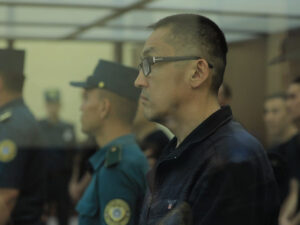
Dauletmurat Tazhimuratov during his sentencing in 2023.
As soon as he learned of this latest hearing, the third one to take place in a matter of days, Tazhimuratov’s brother, Renat, set off from the Karaozek district of Karakalpakstan for Navoi, attempting to cover hundreds of kilometres overnight by car in the hope of attending.
“A week ago, a state-appointed lawyer called me and said there had been a court hearing,” Renat told Havli. “I asked: ‘Why a state lawyer? We have our own.’”
Renat was told another hearing would take place on April 9, only for it to be postponed at short notice. Then, later that same day, the lawyer called again.
“Tomorrow at 9 a.m., there will be a hearing,” he said.
“How are we supposed to make it?” Renat replied. “It’s almost 900 kilometres.”
“I don’t know,” came the reply. “Just come.”
Renat set off immediately and arrived at the penal colony just in time for the start of proceedings.
“At 10 minutes to nine, I was there,” he said. “But they didn’t let me in.”
When he asked why, he was told that officials could not verify his identity.
“The guard said: ‘We don’t know if you really are Renat Tazhimuratov.’ How was I supposed to prove it? Did I need to do a DNA test?” he said.
Renat tried at least to make his presence known to his brother. That, too, proved impossible.
Further attempts to enter the facility were refused.
Dauletmurat Tazhimuratov has some experience of legal processes being heavily tilted against him.
His original trial, held hundreds of kilometres from Karakalpakstan, was presented by the authorities as a model of transparency. In practice, it raised persistent doubts about fairness: defendants delivered collective confessions in court under apparent duress, key testimony unravelled under questioning, and allegations of torture went unexamined.
Tazhimuratov himself rejected the charges and mounted a combative defence, but he received the longest sentence of all those in the dock.
Those proceedings followed the violent suppression of protests in Nukus in July 2022, which erupted after plans to amend the constitution threatened to strip Karakalpakstan of its nominal right to secede. Security forces responded with lethal force against demonstrators.
Tazhimuratov was later cast by prosecutors as a central organiser of the unrest. He has not denied being involved in bringing about the protests, but he has denied any responsibility for the violence, which culminated in at least 21 deaths, according to official figures. Of those killed, four were security personnel and 17 were civilians.
Mindful of the grave reputational damage wrought by the 2005 Andijan massacre, the government limply pledged a transparent investigation, but the commission it established produced little clarity, with key facts remaining obscure and its findings largely unpublished.
Two journeys, then, and two versions of the same country.